Some links pay us a commission if you book or buy. You do not pay extra.
Sam Rayburn: big water, big grass, big days
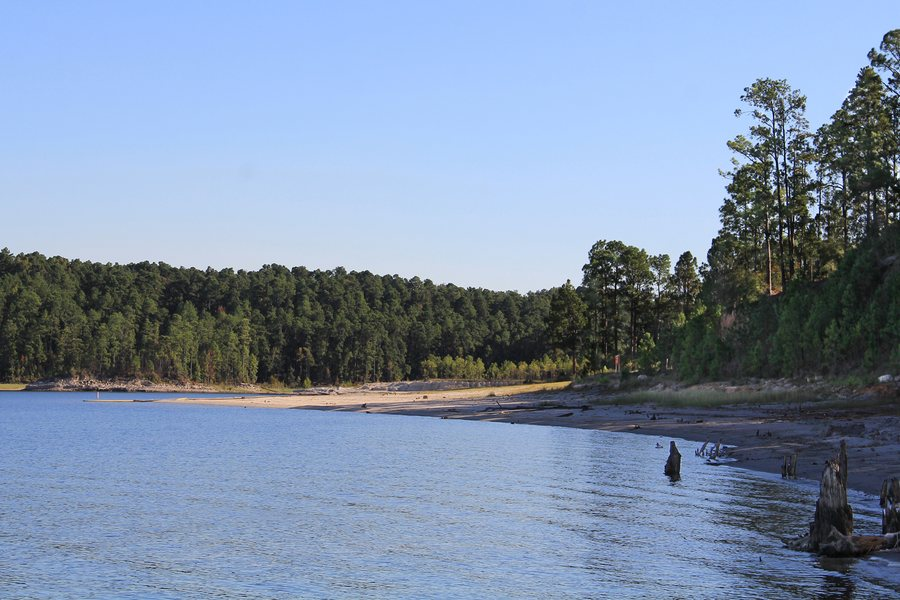

Sam Rayburn is the big one. TPWD lists it at 114,500 acres.
It’s on the Angelina River. The dam is in Jasper County, about 15 miles north of Jasper. It was impounded in 1965 and runs as deep as 80 feet.
TPWD calls the largemouth fishery “excellent” year-round. The main ingredient is hydrilla. Bring lures you’re emotionally prepared to lose to it.
The U.S. Army Corps of Engineers runs the reservoir. Its jobs include flood control and water supply, and, per the Corps itself, “some of the best fishing, camping and boating in Texas.”
Quick facts (from TPWD and the Corps)
| Item | What the source says |
|---|---|
| Location | Angelina River; dam in Jasper County, about 15 miles north of Jasper |
| Surface area | 114,500 acres |
| Max depth | 80 feet |
| Impounded | 1965 |
| Conservation pool | 164.4 ft msl; average fluctuation 7 feet a year |
| Clarity | Relatively clear in the lower lake, off-color in the upper lake |
| Vegetation | Primarily hydrilla, American lotus and pondweed |
| Controlling authority | U.S. Army Corps of Engineers, Sam Rayburn Project Office, Jasper, (409) 384-5716 |
| Bass regs | 14″ minimum (largemouth and smallmouth), 5 black bass daily |
TPWD’s Top 50 largemouth list includes one Sam Rayburn fish: 16.80 pounds, caught May 31, 1997.
How the lake is laid out (per TPWD)
- Lower lake: clearer water. Fish usually hold on vegetation edges, flats, humps and creek channels.
- Upper third: less grass. Timber, brush, laydowns and creek channels do the work.
- Water level matters: big swings can shrink the grass. At high water, flooded trees and bushes make great habitat.
Winter
TPWD says that in fall, winter and spring, Rayburn bass stay active longer during the day and are usually in shallow water. Good news for anyone who hates deep-water winter fishing.
- What to throw: TPWD says crankbaits and spinnerbaits are usually the go-to baits. Lipless crankbaits ripped through grass are a classic cool-water option.
- Where, in general: grass edges and flats close to deeper water, especially on sunny, calm afternoons.
- Buddy tip: when the lipless bait ticks grass, rip it free. That’s often when they eat. Yes, this means you’ll pull a lot of salad.
Pre-spawn
Water warms, fish fatten up and slide toward spawning areas.
- What to throw: spinnerbaits, lipless crankbaits, jigs and swim jigs.
- Where, in general: grass lines and creek mouths between deeper water and the flats where fish will spawn.
- Buddy tip: wind is your friend on a spinnerbait bank. Your hat is not its friend. Bring a strap.
Spawn
Shallow, protected water with some cover. Fish lock onto beds.
- What to throw: soft plastic lizards, creature baits, stick worms and weightless or lightly weighted soft plastics.
- Where, in general: back ends of pockets and protected flats, often around grass or wood.
- Buddy tip: polarized sunglasses aren’t a luxury in spring. They’re a fish-finding tool you wear on your face.
Post-spawn
Fish pull back to the first drops and grass edges, and a topwater bite can get silly.
- What to throw: topwater early, then flukes, swimbaits, Texas rigs and Carolina rigs.
- Where, in general: outside grass edges and points near spawning areas.
- Buddy tip: a frog over matted grass is fun. Setting the hook too early is also an experience. Wait for the weight.
Summer
TPWD says the summer bite usually slows and activity bunches up in early morning, late evening and at night.
- What to throw: TPWD suggests topwater in low light, then plastic worms, jigs and Carolina rigs once the sun is up.
- Where, in general: TPWD says bass move to vegetation edges and man-made brush piles, or onto deep ledges and creek channels.
- Buddy tip: TPWD’s Sam Rayburn page links a free Habitat Structure Viewer with downloadable GPS coordinates for fish habitat structures. That’s a public map, not a secret, so use it.
Fall
Cooling water pulls fish shallow again and bait moves into creeks.
- What to throw: crankbaits and spinnerbaits (TPWD’s cool-season picks), plus topwater and lipless baits for schooling fish.
- Where, in general: creek arms and grass flats wherever you find shad.
- Buddy tip: follow the birds. They’ve been doing this longer than us and they don’t need a graph.
Ramp notes
The Corps lists 27 ramps around the lake, run by the Corps, the Forest Service, TPWD, counties and private marinas. Here are the Corps ramps, from the Corps’ own list:
- Twin Dikes Park and Twin Dikes Public Ramp. South shore, RR 255. Two boat ramps with eight launch lanes in the park. The Corps says the boat ramps are open year-round. Tournament central.
- Mill Creek Park. Spur 165, Brookeland. One two-lane ramp.
- San Augustine Park. FM 1751. One four-lane ramp.
- Rayburn Park. End of FM 3127, north shore.
- Hanks Creek Park. End of FM 2801.
- Monterey Park. End of FM 3124. Ramp only, no camping.
- Marion Ferry Park. End of FM 1669, west shore. One four-lane ramp, no camping.
- Etoile and Ralph McAlister. Both off Texas 103, per the Corps’ ramp list. Closed per USACE, checked Oct 7, 2026. See the closures note below.
Ramp closures (per USACE)
Per USACE, checked Oct 7, 2026: the Corps’ Sam Rayburn park status table shows the boat ramps at Etoile and Ralph McAlister as closed. The other ramps in that table (Hanks Creek, Marion Ferry, Mill Creek, Monterey, Rayburn, San Augustine, Twin Dikes and the Twin Dikes Public Ramp) show open.
The table doesn’t carry a date, so call the project office at (409) 384-5716 before you tow. A closed ramp is a long drive to look at.
- The Corps says the Sam Rayburn Project Office no longer takes cash for Corps campgrounds or boat ramps.
- TPWD notes some ramps may be unusable at low lake levels.
- Check the Corps’ Sam Rayburn page for current ramp status and fees, or call (409) 384-5716.
License reminder
- TPWD requires a fishing license to fish Texas public waters, and a freshwater fishing endorsement on top of it for public fresh water. The Freshwater Package bundles both.
- Some anglers are exempt, including Texas residents under 17. Check TPWD for the full list.
- Annual licenses run from the date of sale through August 31.
- Current fees: TPWD fishing licenses and packages. We don’t print prices.
Special regulations: Sam Rayburn
- Black bass: 14-inch minimum for largemouth and smallmouth. No minimum for Alabama, Guadalupe and spotted bass. Daily bag is 5 in any combination.
- Catfish: blue and channel catfish have no minimum length. The daily bag and possession limit is 50 combined, and no more than 5 can be 30 inches or longer.
- Crappie: 10-inch minimum, 25 daily.
- Consumption advisory: TPWD notes a fish consumption advisory for this reservoir. Read the details before you plan a fish fry.
- Zebra mussels: Texas law requires draining water from your boat and onboard receptacles when leaving or approaching public fresh water.
Full rules: TPWD’s Sam Rayburn regulations page.
Book a guide
114,500 acres is a lot of water to “just figure out.” A guide shrinks it.
Guides we call direct
This guide doesn’t pay us anything. Details are as listed on the guide’s own website on October 7, 2026. Call to confirm.
- Reel um N Guide Service, Lynn Atkinson (Sam Rayburn, Toledo Bend and nearby waters). 979-220-0251. Bass trips for 2 anglers: half day $500, 6 hours $575. Crappie trips are listed too. Website
Sources
Checked October 7, 2026.
- TPWD: Fishing Sam Rayburn Reservoir
- TPWD: Fishing Regulations for Sam Rayburn
- TPWD: Texas Top 50 Largemouth Bass
- TPWD: Sam Rayburn Public Access Facilities
- USACE: Sam Rayburn Lake (home, park status table)
- USACE: Boat Ramps at Sam Rayburn Reservoir
- USACE: Corps Parks at Sam Rayburn Reservoir
- TPWD: Fishing Licenses and Packages
- TPWD: Fishing Endorsements, Tags & Permits
- Reel um N Guide Service: Prices